

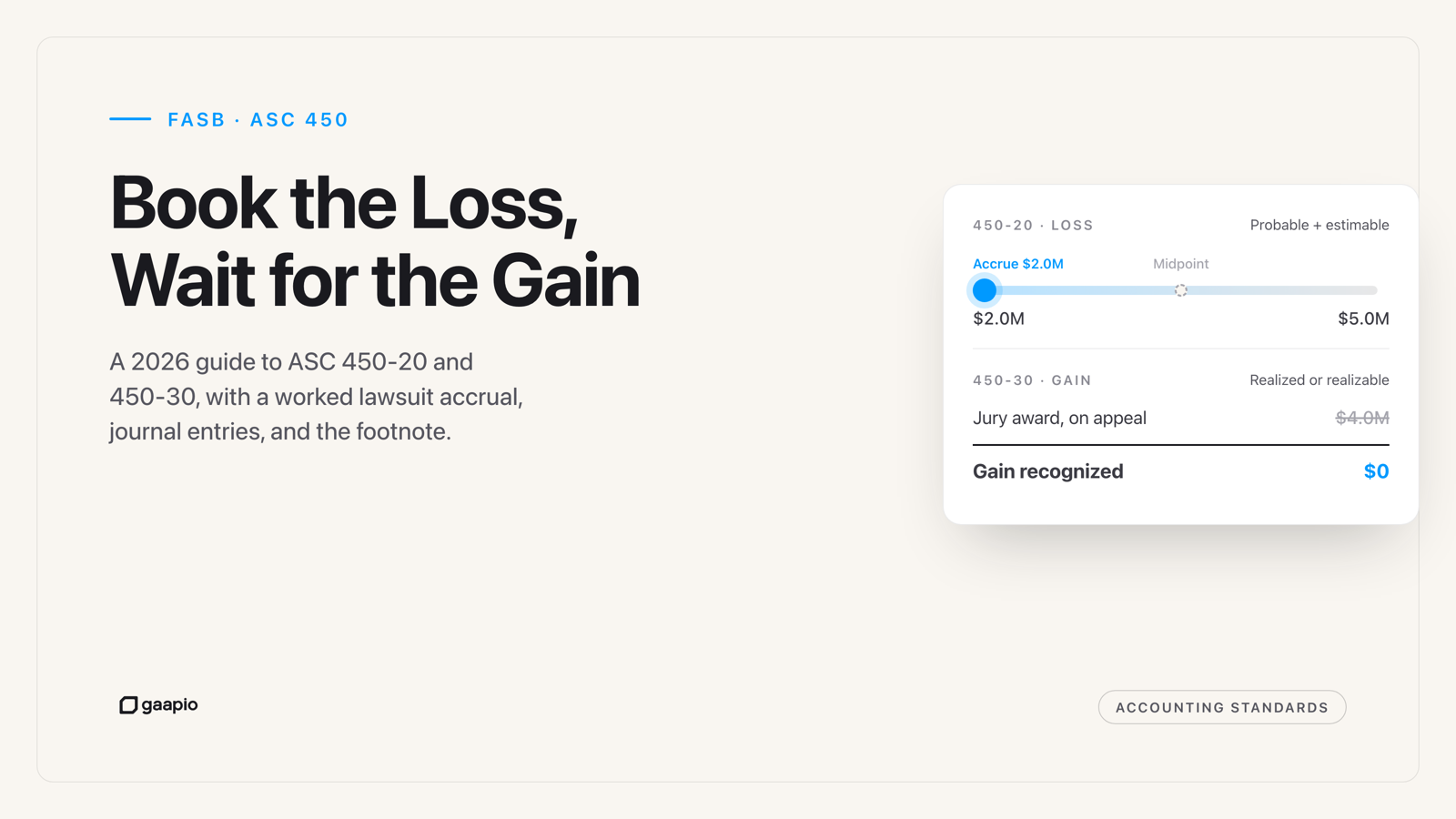
A lawsuit can put a loss on your balance sheet this quarter while the gain on the other side of the same dispute stays off the books until it is realized.
That asymmetry is most of ASC 450. FASB Accounting Standards Codification Topic 450 (FASB ASC 450) covers contingencies: Subtopic 450-20 for losses and Subtopic 450-30 for gains.
The loss side asks whether a loss is probable and can be estimated. The gain side asks a harder question: has the gain actually been realized?
The short version: book the loss when it's probable, and wait for the gain until it's realized.
This guide works through both subtopics the way a reviewer will test them. It covers the recognition thresholds, how to measure a range, what to disclose, and two worked examples with journal entries and footnote language. It's written by Zack Larsen, CPA, Gaapio's cofounder and CEO, with the Gaapio team of CPAs, who build technical accounting software for exactly this kind of judgment call.
Key takeaway: Under ASC 450-20, accrue a loss contingency when a loss is probable and reasonably estimable. If the estimate is a range and no amount in it is better than another, accrue the low end and disclose the rest. Under ASC 450-30, don't recognize a gain contingency until it is realized or realizable, however likely it looks, and disclose it without overstating the odds.
What is ASC 450?
ASC 450 is the FASB Codification Topic on contingencies: conditions that exist at the balance sheet date, with an uncertain outcome that a future event will resolve. It has three parts: 450-10 (overall), 450-20 (loss contingencies), and 450-30 (gain contingencies).
Every contingency has the same three pieces.
A condition exists at the balance sheet date. The outcome is uncertain. And something in the future (a verdict, a settlement, a regulator's decision) will settle it.
Pending litigation, warranty claims, threatened claims nobody has filed yet, and a disputed insurance claim can all start here.
The rules are old and stable.
The core came from FASB Statement No. 5 in 1975, FASB Interpretation No. 14 added the range guidance in 1976, and the Codification carried both forward in 2009.
ASC 450 is also the residual Topic. KPMG's November 2025 executive summary on contingencies describes it as the standard you apply when no other Topic does. So check the specific Topics first: ASC 740 for uncertain tax positions, ASC 460 for guarantees, ASC 410-30 for environmental obligations (which builds on the 450-20 model), ASC 606 for variable consideration in customer contracts, and ASC 326 for credit losses on receivables and other financial assets.
What is ASC 450-20, and when do you accrue a loss contingency?
ASC 450-20 requires you to accrue an estimated loss when two conditions are both met. First, information available before the financial statements are issued (or available to be issued) shows it is probable that a liability was incurred or an asset impaired at the balance sheet date. Second, the amount can be reasonably estimated (ASC 450-20-25-2).
If either condition fails, you don't accrue. You may still have to disclose.
The balance sheet date matters. New information that arrives before issuance about a condition that already existed at year-end, such as a mediation on a suit filed in June, goes into the accrual.
A loss from an event that happened after year-end is not accrued (ASC 450-20-25-6). Disclose it if needed to keep the statements from being misleading (ASC 450-20-50-9 and ASC 855-10-50-2).
What do probable, reasonably possible, and remote mean?
The ASC 450-20 glossary defines three bands:
- Probable: the future event or events are likely to occur.
- Reasonably possible: more than remote but less than likely.
- Remote: the chance is slight.
The Codification gives no percentage. Probable is a higher bar than "more likely than not," the ASC 740 threshold for tax positions, and practice reads it as a high likelihood.
The hardest part is often human. Concluding that a loss is probable on a case your company is still fighting can feel like conceding the case.
An accrual is an accounting estimate, and it sits alongside the legal defense: counsel can fight the claim while the financial statements reflect the likely cost of resolving it. Write the disclosure with counsel so it describes the matter without waiving privilege.
What if the loss is a range?
If one amount in the range is a better estimate than any other, accrue that amount. If no amount is better, accrue the minimum of the range and disclose the reasonably possible loss above it (ASC 450-20-30-1, carried forward from FASB Interpretation No. 14).
This is where first drafts most often go wrong. The midpoint feels fair, but US GAAP points to the low end when nothing in the range stands out. IFRS lands somewhere else, covered below.
Two more measurement rules come up in review:
- Remeasure every reporting date. A change in the estimate is a change in accounting estimate, recognized prospectively, per KPMG's executive summary.
- Don't discount, as a rule. Discounting is allowed only when the amount and timing of payments are fixed or reliably determinable, per PwC's Financial statement presentation guide, section 23.4.
What is ASC 450-30, and when can you recognize a gain contingency?
ASC 450-30 says a contingency that might result in a gain usually should not be reflected in the financial statements, because doing so might recognize revenue before it is realized (ASC 450-30-25-1). In practice, you recognize the gain when it is realized or realizable: all uncertainties are resolved, and cash or a claim to cash is in hand.
Probability doesn't move the answer, which makes gain contingency accounting one of the most conservative areas of US GAAP. In KPMG's words, "probability is not a factor in the recognition of gain contingencies." A 95% chance that the verdict survives appeal still leaves you with a gain contingency.
What does realized or realizable mean in practice?
Deloitte's Roadmap on contingencies, section 3.4 works through the litigation cases:
- A verdict or award that can still be appealed is generally not realized.
- A settlement that still needs regulatory or legislative approval, such as a city council vote, is not realized until every approval is in hand, even when approval is expected to be routine.
- Cash in escrow is not enough when you don't yet know how much of it you will receive. A known, nonrefundable amount with no appeal left can be.
Timing works differently too. A gain contingency that resolves after year-end but before the statements are issued is generally not pulled back into the year just ended (Deloitte Roadmap, section 3.8). The same news on the loss side would update the accrual.
Insurance recoveries: where the two subtopics meet
An expected recovery of a loss you have already recognized follows the loss recovery model. You recognize a receivable when recovery is probable and reasonably estimable, capped at the loss you recognized.
Anything above the recognized loss is a gain contingency under ASC 450-30. KPMG calls this the mixed model.
The same split applies to property damage. Under ASC 610-30, proceeds up to the asset's carrying amount follow the loss recovery model, and any excess, such as replacement cost above book value, is a gain contingency. Business interruption recoveries of lost profit generally fall under the gain contingency model (Deloitte Roadmap, sections 4.3 and 4.6).
Three details auditors check:
- Disputed claims. If the insurer is contesting the claim or it is in litigation, PwC describes a rebuttable presumption that recovery is not probable.
- Gross presentation. The receivable and the liability are shown gross on the balance sheet. Offsetting requires the right-of-setoff conditions in ASC 210-20-45-1, which rarely hold, and ASC 720-20-45-1 generally prohibits netting insurance receivables against the liability.
- Income statement. The recovery generally goes in the same line as the related loss, up to the amount of the loss (ASC 410-30-45-4, applied by analogy). Any excess is a gain, usually presented separately.
ASC 450-20 vs. ASC 450-30: how do the rules compare?
The two subtopics share a definition of contingency and almost nothing else. Losses are recognized on probability. Gains wait for realization.
- Recognition threshold. Loss (450-20): probable and reasonably estimable (450-20-25-2). Gain (450-30): realized or realizable, and not reflected before realization (450-30-25-1).
- Role of probability. Loss: drives the answer (probable, reasonably possible, or remote). Gain: not a factor.
- Measurement. Loss: the best estimate in the range, or the minimum if no amount is better (450-20-30-1), generally undiscounted. Gain: nothing to measure until realized, then the amount realized or realizable.
- Disclosure when not recognized. Loss: required when a loss is reasonably possible, or probable but not estimable. Give the nature, plus an estimate, a range, or a statement that no estimate can be made (450-20-50-3 to 50-5). Gain: adequate disclosure, without misleading implications about the likelihood of realization (450-30-50-1).
- Remote matters. Loss: generally no disclosure (guarantees under ASC 460 are an exception). Gain: the misleading-implications test still applies.
- Resolved after year-end, before issuance. Loss: updates the accrual if the condition existed at the balance sheet date. Gain: generally not recognized in the earlier period.
- Common examples. Loss: lawsuits against you, warranties, environmental matters, unasserted claims. Gain: lawsuits you filed, awards on appeal, insurance proceeds above the recognized loss, contested refund claims outside ASC 740.
What does ASC 450 require you to disclose?
For ASC 450 loss contingencies, disclose the nature of any accrual and, when needed to keep the statements from being misleading, the amount. When there's at least a reasonable possibility of a loss, or of a loss above what you accrued, disclose the nature of the contingency and an estimate of the possible loss or range, or state that no estimate can be made (ASC 450-20-50-1, 50-3 and 50-4).
The rest of the loss-side checklist:
- Wording. Call it an estimated liability. ASC 450-20-50-1 says the term "reserve" shall not be used for an accrued loss contingency.
- Unasserted claims. Disclose when it is probable a claim will be asserted and an unfavorable outcome is reasonably possible (ASC 450-20-50-6).
- Legal costs. Accruing expected legal fees with the contingency, or expensing them as incurred, is a policy choice. Apply it consistently and disclose it (ASC 450-20-S99-2).
- SEC filers. Add Regulation S-K Item 103 (legal proceedings), SAB Topic 5.Y for environmental and product liability matters, and the staff's expectation that disclosures foreshadow a material accrual before it lands.
- ASU 2024-03. Under the new expense disaggregation rules for public business entities, effective for annual periods beginning after December 15, 2026, and interim periods beginning after December 15, 2027, PwC notes that, after adoption, expense from an ASC 450 accrual may require separate tabular disclosure in the period it is accrued.
For a gain contingency, the rule is one sentence: make adequate disclosure, and take care to avoid misleading implications about the likelihood of realization (ASC 450-30-50-1).
Is there a new FASB proposal on loss contingency disclosures?
The FASB last proposed expanded loss contingency disclosures in a June 2008 exposure draft and a revised July 2010 draft. Both would have expanded loss contingency disclosures, including some remote matters with a potentially severe impact.
The FASB removed the project from its agenda in July 2012, per Deloitte's Roadmap, section 1.2.
The FASB's 2026 agenda updates list no project on loss contingency disclosures. The disclosure requirements today are the ones in ASC 450-20-50, and for SEC filers, the staff tests compliance with them through comment letters.
How do you account for a lawsuit with a range of possible losses? A worked example
Here are the facts. Calder Manufacturing (illustrative) is a calendar-year public company.
- In June 2026, a customer sues Calder for $12.0 million, alleging defective components shipped in 2025.
- At December 31, 2026, the case is in discovery.
- In February 2027, before the 10-K is issued, the parties mediate. Outside counsel concludes an unfavorable outcome is probable. A settlement or judgment would most likely fall between $2.0 million and $5.0 million, with no amount in that range more likely than another.
- Calder's product liability policy pays up to $1.5 million per claim after a $500,000 deductible. The insurer has confirmed coverage in writing and is not contesting the claim.
- Calder's policy is to expense legal costs as incurred.
Step 1: Recognition
The condition existed at year-end: the components shipped in 2025 and the suit was filed in June. The mediation happened before issuance, so it counts. A loss is probable and a range can be estimated, so Calder accrues.
Step 2: Measurement
No amount in the range is a better estimate, so Calder accrues the minimum: $2.0 million. The $12.0 million claim and the $3.5 million midpoint are both wrong answers here.
Step 3: The insurance recovery
Coverage is confirmed and undisputed, so recovery is probable. The recovery ($1.5 million) doesn't exceed the recognized loss ($2.0 million), so the full amount is recognized under the loss recovery model, shown gross.
Step 4: The loss contingency journal entries at December 31, 2026
Dr  Litigation expense                      2,000,000
      Cr  Accrued litigation liability                    2,000,000
    To accrue the low end of the estimated range of loss
    (ASC 450-20-30-1)

Dr  Insurance recovery receivable           1,500,000
      Cr  Litigation expense                              1,500,000
    To recognize the probable insurance recovery,
    capped at the loss recognized
The net hit to 2026 pretax income is $500,000, the deductible. The balance sheet shows a $2.0 million liability and a separate $1.5 million receivable.
Step 5: The footnote
Here's illustrative language for the commitments and contingencies note. Adapt it with counsel.
Litigation. In June 2026, a customer filed a lawsuit against the Company alleging that components the Company supplied in 2025 were defective and seeking damages of approximately $12.0 million. In February 2027, the parties participated in mediation. Based on developments in the matter, including the February 2027 mediation, and the advice of outside counsel, the Company has concluded that a loss is probable and estimates the range of loss at $2.0 million to $5.0 million. Because no amount within that range is a better estimate than any other, the Company has recorded an estimated liability of $2.0 million, the low end of the range, within accrued liabilities as of December 31, 2026. It is reasonably possible that the Company will incur additional loss of up to $3.0 million in excess of the amount accrued. The Company's insurer has confirmed coverage of this matter up to its $1.5 million policy limit, and the Company has recorded a corresponding insurance recovery receivable within other current assets. Losses above that limit are not insured. The Company expenses legal costs as incurred.
Step 6: What happens next
In June 2027, after the first-quarter 10-Q is issued, Calder settles for $3.2 million. The insurer pays its $1.5 million limit.
Dr  Litigation expense                      1,200,000
      Cr  Accrued litigation liability                    1,200,000
    Change in estimate, recognized in Q2 2027

Dr  Accrued litigation liability            3,200,000
      Cr  Cash                                            3,200,000

Dr  Cash                                    1,500,000
      Cr  Insurance recovery receivable                   1,500,000
The 2026 statements are not restated. A good estimate that later changes is a change in estimate.
One timing check: if the settlement had been signed in February 2027, before issuance, the condition existed at year-end. The 2026 accrual would be $3.2 million.
What a reviewer will check on this file
- The date of counsel's assessment, and that it came before the issuance date.
- What supports the low end: mediation positions, comparable settlements, or counsel's analysis.
- Written confirmation that the insurer isn't contesting coverage.
- How the Q2 and Q3 2026 10-Qs described the suit, so the accrual did not appear without warning.
How do you handle a gain contingency you can't recognize yet? A worked example
Same company, other side of the courtroom. Calder sued a former supplier for breach of contract.
- In November 2026, a jury awards Calder $4.0 million.
- In December 2026, the supplier appeals. Counsel expects the verdict to hold.
- In February 2027, before the 10-K is issued, the supplier settles for $3.0 million in cash, and Calder receives it.
The entry at December 31, 2026
None. At year-end the award was on appeal, so it wasn't realized or realizable. The February settlement resolves the matter, but a gain that resolves after year-end generally isn't pulled back into 2026.
Meanwhile the supplier, applying ASC 450-20, may well have accrued a loss after the verdict. Deloitte's Roadmap walks through the same pattern with an arbitration award: one party records a loss while the other records no gain.
The entry in Q1 2027
Dr  Cash                                    3,000,000
      Cr  Gain on litigation settlement                   3,000,000
Classify the gain as operating or nonoperating based on its nature. Many companies present it in other income.
The footnote
Subsequent event: litigation settlement. In November 2026, a jury returned a verdict in the Company's favor in its breach of contract lawsuit against a former supplier and awarded damages of $4.0 million. The supplier appealed the verdict in December 2026. In February 2027, the parties settled the matter for $3.0 million, which the Company received in cash. The Company will recognize a gain of $3.0 million in the first quarter of 2027, the period in which the settlement was realized. No amount related to this matter has been recognized in the accompanying financial statements.
The disclosure states the facts and the settled amount. It doesn't call the award "expected" or describe the outcome as likely, which is how a gain footnote picks up misleading implications.
How does ASC 450 compare with IFRS (IAS 37)?
IAS 37 recognizes liabilities earlier and measures them differently. Under IAS 37, "probable" means more likely than not, so a provision is recognized at a lower threshold than an ASC 450-20 accrual.
The other differences that matter in a dual-reporting close:
- Ranges. For a continuous range where every point is as likely as any other, IAS 37 uses the midpoint. ASC 450-20 uses the minimum.
- Discounting. IAS 37 discounts a provision when the time value of money is material. ASC 450 generally doesn't discount.
- Pending changes. The IASB is still redeliberating targeted amendments to IAS 37 proposed in November 2024, including the discount rate for provisions. Check the project status before a dual-reporting close.
- Terms. Under IFRS, a "contingent liability" is one that is not recognized. Under US GAAP, a loss contingency can be accrued.
- Gains. Under IAS 37, a contingent asset is never recognized. When the inflow becomes virtually certain, the asset is no longer contingent and is recognized. A contingent asset is disclosed when an inflow is probable. The answer is often close to ASC 450-30, reached by a different test.
- Insurance recoveries. IAS 37 recognizes a reimbursement only when receipt is virtually certain. ASC 450 uses probable. Calder's $1.5 million receivable would face a higher bar under IFRS.
What do auditors and the SEC staff push on?
The same handful of issues show up in review comments and SEC comment letters:
- Accruing the midpoint when nothing in the range is a better estimate.
- Accruing nothing because the loss can't be estimated precisely. A reasonable estimate can be a range, and a range has a minimum.
- No foreshadowing. A matter's first disclosure arrives in the same quarter as a large accrual.
- Boilerplate. "The outcome cannot be predicted," without the estimate, range, or no-estimate statement that ASC 450-20-50-4 requires.
- Netting the insurance receivable against the liability on the balance sheet.
- Booking a gain early because a verdict came in or settlement talks are "advanced."
How Gaapio handles ASC 450 memos and disclosures
Gaapio is an AI-powered technical accounting platform built by CPAs. On a contingency, that means research anchored to the licensed FASB Codification and Big 4 guidance through Gaapio's FASB research.
It asks follow-up questions before it drafts: when is counsel's assessment dated, and is the insurer contesting coverage? The result is an ASC 450 accounting memo with clickable citations a reviewer can check line by line.
The footnote disclosure comes from the same facts, so a reviewer can tie the accrual in the memo to the range in the note. You make the probable call. Gaapio keeps the paper behind it consistent, cited, and ready for the reviewer.
Want to see an ASC 450 memo built from your own facts? Request a demo.
Frequently asked questions
What is ASC 450-20?
ASC 450-20 is the FASB Codification Subtopic on loss contingencies. It requires a company to accrue a loss when it is probable that a liability was incurred or an asset impaired at the balance sheet date and the amount can be reasonably estimated, and to disclose losses that are reasonably possible.
What is ASC 450-30?
ASC 450-30 is the FASB Codification Subtopic on gain contingencies. It says a gain contingency usually should not be recognized before it is realized or realizable, and it requires adequate disclosure that avoids misleading implications about whether the gain will be realized.
What is the difference between ASC 450-20 and ASC 450-30?
ASC 450-20 recognizes losses based on probability, while ASC 450-30 recognizes gains only on realization. A loss that is probable and estimable is accrued. A gain is not recognized until it is realized or realizable, however likely it is.
When should a loss contingency be accrued?
A loss contingency should be accrued when both conditions in ASC 450-20-25-2 are met: it is probable that a liability was incurred or an asset impaired at the balance sheet date, and the amount can be reasonably estimated. Information available before the financial statements are issued counts toward both conditions.
How much do you accrue when the loss is a range?
Accrue the best estimate within the range, and if no amount is better than any other, accrue the minimum of the range (ASC 450-20-30-1). Then disclose the reasonably possible loss above the amount accrued.
Can you recognize a gain contingency before you receive cash?
Yes, if the gain is realizable. That means all uncertainties are resolved and you hold cash or a claim to cash, such as a final judgment with no appeal left. A verdict that can still be appealed, or a settlement awaiting approval, is not enough.
Do you have to disclose a remote loss contingency?
Generally no, because ASC 450-20 requires disclosure only when a loss is at least reasonably possible. Certain guarantees under ASC 460 must be disclosed even when the chance of loss is remote.
Is an insurance recovery a gain contingency?
Only the part above the recognized loss. A probable recovery of a loss you've already recognized is recorded as a receivable, capped at that loss. Any expected recovery above the recognized loss is a gain contingency under ASC 450-30.
Related reading
- Why technical accounting memos matter
- Building an audit-ready documentation process
- The new income tax disclosures under ASU 2023-09
Sources: FASB ASC 450-10, 450-20 and 450-30; Deloitte, Roadmap: Contingencies, Loss Recoveries, and Guarantees; PwC, Financial statement presentation guide, section 23.4; KPMG, Handbook: Contingencies, commitments and guarantees and its November 2025 executive summary; IFRS Foundation, IAS 37.