

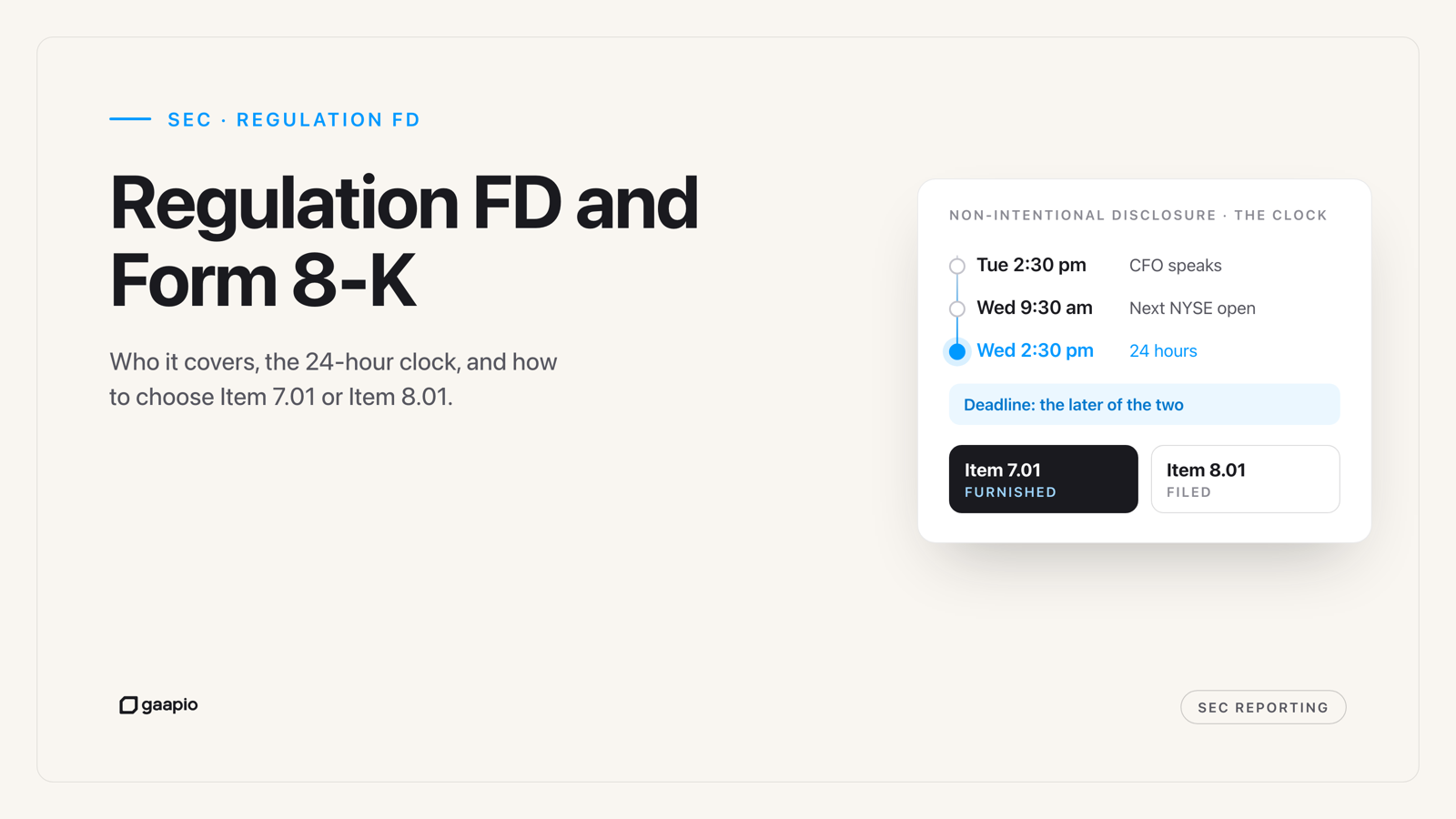
Next time your CFO walks out of a closed-door breakout at an investor conference and mentions that the year is "tracking to the top of the range," your reporting team has a Regulation FD question with a clock on it. The room held a dozen analysts and portfolio managers. The rest of the market heard nothing.
Regulation FD (Regulation Fair Disclosure, or Reg FD) is short: four sections of 17 CFR Part 243. Applying it is harder, because it asks for a materiality judgment in real time and then sets a deadline measured in hours. This guide covers what the rule requires, how the Form 8-K items fit, and a worked example that runs from the selective comment to the furnished 8-K.
Key takeaway: Regulation FD requires an SEC reporting company that shares material nonpublic information with market professionals, or with shareholders likely to trade on it, to make that information public. If the disclosure was intentional, the public disclosure has to be simultaneous. If it wasn't, the company has until the later of 24 hours or the next NYSE open after a senior official learns of it. A Form 8-K is the standard method: Item 7.01 furnishes the information, and Item 8.01 files it.
What is Regulation FD?
Regulation FD, the SEC's Regulation Fair Disclosure, is the rule that addresses selective disclosure. When a public company shares material nonpublic information with market professionals, or with shareholders likely to trade on it, the company must make the same information public, either simultaneously or promptly.
The SEC adopted it on August 15, 2000 (Release No. 33-7881), and it took effect October 23, 2000. The rule text is 17 CFR 243.100 through 243.103.
Reg FD applies to issuers with a class of securities registered under Section 12 of the Exchange Act or with a reporting obligation under Section 15(d), including closed-end funds. Foreign private issuers, foreign governments and investment companies other than closed-end funds, such as mutual funds, are outside it. Private companies are outside it too, until they become SEC reporting companies.
Who does Regulation FD cover?
Reg FD covers what certain people at the company say to certain people outside it. On the company side, it applies to senior officials (directors, executive officers, investor relations or public relations officers, and anyone with similar functions) and to any other officer, employee or agent who regularly communicates with market professionals or shareholders.
On the recipient side, Rule 100(b)(1) lists four groups:
- Broker-dealers and their associated persons, which includes sell-side analysts
- Investment advisers, certain institutional investment managers, and their associated persons
- Investment companies, and funds that would be investment companies but for Section 3(c)(1) or 3(c)(7), such as most hedge funds and private equity funds, and their affiliated persons
- Holders of the company's securities, when it's reasonably foreseeable they'll trade on the information
Rule 100(b)(2) then excludes three kinds of disclosure:
- To people who owe the company a duty of trust or confidence, such as outside counsel, investment bankers and auditors
- To people who expressly agree to keep the information confidential. A promise to follow the securities laws isn't enough (C&DI 101.06), but a separate promise not to trade isn't required either (C&DI 101.05)
- In connection with most registered securities offerings, through the registration statement, prospectus, free writing prospectus, Rule 134 and 135 notices, and oral communications after filing. The exclusion doesn't cover certain Rule 415 offerings, such as resale shelves and S-8 plans. A resale shelf combined with a primary capital-raising offering by the company can still use it
Employees fall outside the rule because they aren't outside the company (C&DI 101.09). The adopting release also says Reg FD doesn't apply to ordinary-course business communications with customers or suppliers, or to disclosures to the media.
Credit rating agencies had their own exclusion until 2010, when the SEC removed it as Section 939B of the Dodd-Frank Act required (Release No. 33-9146). Today, if a rating agency falls within a Rule 100(b)(1) category, the company needs another exclusion, and most companies get an express confidentiality agreement.
What makes information "material" and "nonpublic" under Reg FD?
Reg FD doesn't define materiality, so it uses the Supreme Court standard: information is material if there is a substantial likelihood a reasonable investor would consider it important, meaning it would significantly alter the "total mix" of available information (TSC Industries v. Northway, 1976; Basic v. Levinson, 1988). Information is nonpublic until it has been disseminated in a way that reaches investors generally.
The adopting release lists seven types of information that should be reviewed carefully for materiality:
- Earnings information
- Mergers, acquisitions, tender offers, joint ventures, or changes in assets
- New products or discoveries, or developments with customers or suppliers, such as winning or losing a contract
- Changes in control or in management
- A change in auditors, or notice from the auditor that the company may no longer rely on its audit report
- Events about the company's securities: defaults, redemptions, repurchase plans, stock splits, dividend changes, changes to holders' rights, and sales of additional securities
- Bankruptcies or receiverships
Three patterns that cause most Reg FD trouble
Private earnings guidance. The adopting release says an official who discusses earnings estimates privately with an analyst "takes on a high degree of risk." That holds whether the guidance is explicit or implied.
Confirming guidance. A company can privately reaffirm a public forecast only if the confirmation adds nothing material. C&DI 101.01 notes that the answer can change with the time since the original forecast and with events in between. A "we're still comfortable" in the last week of the quarter says much more than the same words the day after the earnings call.
The mosaic. The release lets a company share a nonmaterial detail even if an analyst uses it to complete a larger picture. It also says a company can't make material information immaterial by breaking it into pieces. Commenting on an analyst's model is fine until the comments signal where the numbers are going (C&DI 101.03).
When does a company have to disclose: simultaneously or promptly?
The answer turns on whether the selective disclosure was intentional. Intentional disclosures require simultaneous public disclosure, and non-intentional ones require prompt public disclosure (Rule 100(a)).
A disclosure is intentional when the person making it knows, or is reckless in not knowing, that the information is both material and nonpublic (Rule 101(a)). For a planned disclosure, such as new guidance at an investor day, that means the information goes public before or at the same moment the room hears it.
"Promptly" means as soon as reasonably practicable, and no later than the later of 24 hours or the start of the next day's NYSE trading (Rule 101(d)). The clock starts when a senior official learns of the disclosure and knows, or is reckless in not knowing, that the information was material and nonpublic.
How does Reg FD timing fit with the 8-K four-business-day deadline?
Most Form 8-K items allow four business days. General Instruction B.1 to Form 8-K carves out Reg FD: an Item 7.01 report, or an Item 8.01 filing made solely to satisfy Reg FD, follows the Reg FD deadline instead.
The two clocks can collide. If the selective comment reveals an event that triggers a required item, such as a material definitive agreement under Item 1.01, the information has to be public on the Reg FD clock even though the Item 1.01 report isn't due for four business days. Many teams file the required item early at that point rather than disclose the same event twice.
How do you make "public disclosure" under Reg FD?
You file or furnish a Form 8-K, or you use another method reasonably designed to give the information broad, non-exclusionary distribution to the public (Rule 101(e)). The 8-K is the only method the rule names. Using one removes the question of whether the method reached the public broadly enough.
Methods that can satisfy Rule 101(e):
- A Form 8-K under Item 7.01 or Item 8.01, or under Item 2.02 for results of a completed quarter or year
- A press release distributed through a widely circulated news or wire service
- A conference call or webcast the public can access, announced in advance with the date, time, subject matter and access details (C&DI 102.01)
- A timely EDGAR filing such as a 10-Q, as long as the information isn't buried or released piecemeal (C&DI 102.02)
- The company website or a social media channel, if it is a recognized channel of distribution, the posting is accessible to the market, and it can meet the Reg FD timing
The last one comes from the SEC's 2008 guidance on company websites (Release No. 34-58288) and its 2013 Netflix report (Release No. 34-69279).
The 2013 report followed a July 2012 post on CEO Reed Hastings' personal Facebook page about monthly streaming hours. The SEC brought no case, but it said a personal page that investors were never told to watch is unlikely to meet the standard, and that companies should tell investors in advance which channels they will use.
Two methods that don't work: a shareholder meeting open to the public but not webcast or otherwise broadcast (C&DI 102.05), and a nonpublic meeting with members of the press in the room (C&DI 102.06).
Should a Reg FD disclosure go under Item 7.01 or Item 8.01?
Use Item 7.01 when you want to furnish the information, and Item 8.01 when you want it filed. Either one satisfies Reg FD; the choice changes your liability profile and whether the information flows into your registration statements.
Item 7.01 (Regulation FD Disclosure)
- Status: furnished
- Exchange Act Section 18 liability: no, unless you state it is filed or incorporate it by reference into another filing (General Instruction B.2)
- Incorporated by reference into Forms S-3 and S-8: no, unless you expressly incorporate it
- Typical use: investor presentations, guidance updates, conference materials
Item 8.01 (Other Events)
- Status: filed
- Exchange Act Section 18 liability: yes
- Incorporated by reference into Forms S-3 and S-8: yes, through the forward incorporation language every S-3 and S-8 must include. The information becomes part of the registration statement and can carry Securities Act Section 11 liability
- Typical use: information the company wants on the record and in its shelf, such as litigation outcomes, recast financial statements, and updates during an offering
Same for both items
- Rule 10b-5 antifraud liability applies
- The report isn't an admission that information required solely by Reg FD is material (General Instruction B.6)
- When used for Reg FD, the Reg FD deadline applies instead of four business days (General Instruction B.1)
Two details trip people up. Earnings releases for a completed quarter or year go under Item 2.02, which is also furnished. Item 2.02(b) lets the follow-up earnings call skip its own 8-K if it is complementary to the furnished release and starts within 48 hours after it, is broadly accessible, was announced by a widely disseminated press release with access details, and has its financial and other statistical information posted on the website with any required Regulation G reconciliation.
When one 8-K covers both Item 7.01 and other items, General Instruction B.2 treats every exhibit relating to Item 7.01 as furnished unless Item 9.01 says which exhibits are filed.
Worked example: does this comment need a Reg FD 8-K, and under which item?
Here is how a reporting team might run the decision from the opening scenario. The company and numbers are illustrative.
The facts. Halvorsen Instruments, Inc. is a calendar-year, NYSE-listed large accelerated filer with an effective Form S-3 shelf and no offering underway. On Wednesday, July 29, 2026, with its second-quarter results, it guided full-year 2026 revenue to $410 million to $425 million. Analyst consensus sits at $416 million.
On Tuesday, September 15, 2026, at a broker-hosted conference, the CFO joins a breakout session that isn't webcast. The 12 attendees are sell-side analysts and buy-side portfolio managers.
At about 2:30 p.m. Eastern, asked about the year, the CFO says revenue is tracking to the top of the range and bookings are running ahead of plan. The IR director flags it to the CFO and general counsel at 3:10 p.m.
Step 1: Was the information already public?
The team compares the comment to the July 29 earnings release, the earnings call transcript, the second-quarter 10-Q and anything said publicly since. The range is public. "Top of the range" and the bookings trend are not.
Step 2: Is it material?
The top of the range is $425 million, $9 million above consensus and $7.5 million above the midpoint. Qualitatively, it is earnings information, the first category in the adopting release, delivered to the people whose estimates move the stock. The team concludes it is material and writes down why.
On a close call about guidance, many companies choose to disclose. An extra 8-K has costs, including the expectation that the company will update again, but those are usually smaller than the cost of an enforcement action.
Step 3: Was the audience covered, and does an exclusion apply?
Sell-side analysts are associated persons of broker-dealers, and the portfolio managers work for investment advisers, so all of them fall under Rule 100(b)(1). Nobody agreed to keep the information confidential, and the conference isn't an offering communication. No exclusion applies.
Step 4: Which clock applies?
The CFO didn't set out to update guidance, but Rule 101(a) asks whether the CFO knew, or was reckless in not knowing, that the comment was material and nonpublic. The SEC has charged similar private guidance before: Raytheon in 2002, after its CFO privately told analysts their first-quarter estimates were too high, and Flowserve in 2005, after its CEO privately reaffirmed earnings guidance. The team records why it concludes the disclosure was non-intentional, and treats that as a position the SEC could reject.
The CFO will want to know whether this is already a violation. If the disclosure was intentional, it happened in the room. Either way, the remedy is the same: public disclosure now, which is also what limits the damage.
The conservative reading starts the clock when the CFO spoke, at about 2:30 p.m. Tuesday, since the CFO is a senior official and knew what was said. That puts the outer deadline at the later of 24 hours (2:30 p.m. Wednesday) or the NYSE open Wednesday (9:30 a.m.), so 2:30 p.m. on Wednesday, September 16.
The IR director's 3:10 p.m. flag is the latest defensible start, which would move the deadline to 3:10 p.m. Wednesday. Either way, the outer deadline falls on Wednesday afternoon, and the team plans to be public before the 9:30 a.m. open, so the difference doesn't matter here.
Step 5: Press release, 8-K, or both?
Both. The company issues a press release over a national wire service at 7:00 a.m. Eastern on Wednesday saying it expects full-year revenue at the high end of its range and that bookings are running ahead of plan, and furnishes an 8-K right after.
Either one satisfies Rule 101(e) on its own. The 8-K puts the disclosure on EDGAR, where analysts, counsel and the SEC staff will look for it first.
Step 6: Item 7.01 or Item 8.01?
Item 7.01. The information is a forward-looking outlook, no offering is underway, and the company has no reason to pull its guidance into the S-3 through incorporation by reference. The press release still carries meaningful cautionary language so the company can rely on the PSLRA safe harbor for forward-looking statements, because Rule 10b-5 applies to furnished information.
The team would choose Item 8.01 if it were in the middle of a shelf takedown and wanted the update in the registration statement, or if the information were a hard fact the company wants in the filed record, such as a litigation outcome or a regulatory approval that no other item requires.
Sample Form 8-K language, Item 7.01 (illustrative):
Item 7.01 Regulation FD Disclosure.
On September 16, 2026, Halvorsen Instruments, Inc. (the "Company") issued a press release updating its full-year 2026 revenue outlook. A copy of the press release is furnished as Exhibit 99.1 to this Current Report on Form 8-K.
The information in this Item 7.01, including Exhibit 99.1, is furnished and shall not be deemed "filed" for purposes of Section 18 of the Securities Exchange Act of 1934, as amended (the "Exchange Act"), or otherwise subject to the liabilities of that section, and shall not be incorporated by reference into any filing under the Securities Act of 1933, as amended, or the Exchange Act, except as expressly set forth by specific reference in such a filing. The furnishing of this information is not an admission as to the materiality of any information in this report that is required to be disclosed solely by Regulation FD.
Item 9.01 Financial Statements and Exhibits.
(d) Exhibits. 99.1: Press release dated September 16, 2026. 104: Cover Page Interactive Data File (embedded within the Inline XBRL document).
The Item 8.01 alternative (illustrative):
Item 8.01 Other Events.
On September 16, 2026, the Company announced that it expects full-year 2026 revenue at the high end of its previously announced range of $410 million to $425 million, and that bookings to date are running ahead of the Company's plan. [Cautionary language for forward-looking statements follows.]
Step 7: Document it and fix the cause
The team writes a short memo to file: what was said and to whom, the materiality analysis, the timing, the item choice, and the disclosure committee's sign-off. Then it fixes the cause. Conference prep gets pre-cleared talking points, and IR sits in every breakout.
What happens if a company violates Regulation FD?
The SEC enforces Reg FD, and investors can't bring a private suit based on a Reg FD failure alone. Rule 102 says a failure to make a disclosure required solely by Reg FD isn't by itself a Rule 10b-5 violation, though a selective statement that is false or misleading can still create 10b-5 liability. Rule 103 says it doesn't affect the company's eligibility for Forms S-3, S-8, SF-3 or N-2, or its Rule 144(c) current public information status.
The SEC brings few Reg FD cases, and most involve guidance or earnings signals. In December 2022, AT&T agreed to pay $6.25 million, and three investor relations executives agreed to pay $25,000 each, to settle charges that they shared internal smartphone sales data with analysts at about 20 firms in 2016 to bring first-quarter estimates down (SEC press release 2022-215).
At the time, the SEC called it the largest penalty ever in a Reg FD case. AT&T and the executives neither admitted nor denied the allegations.
Social media is now part of the record. In September 2024, DraftKings agreed to pay $200,000 after its PR firm posted unreleased second-quarter business information on the CEO's personal X and LinkedIn accounts, seven days before the earnings release (SEC press release 2024-149).
The posts came down quickly, but the information wasn't made public until the earnings release. It is the risk the 2013 Netflix report described: a personal account investors were never told to watch.
The SEC has also lost in court. In 2005, the court in SEC v. Siebel Systems dismissed the SEC's Reg FD complaint. It found the private remarks matched what the company had already said publicly, and it warned against parsing executives' words too closely.
Separately, anyone who trades on a selective disclosure can face insider trading liability under a different body of law.
How do reporting teams stay Reg FD compliant day to day?
Most Reg FD programs come down to six habits:
- A written disclosure policy that names the authorized spokespeople
- Pre-cleared talking points for conferences and one-on-ones, with IR in the room
- A quiet period before earnings
- An escalation path that reaches the CFO, general counsel and the reporting team that drafts the 8-K within minutes, so the 24-hour clock never surprises anyone
- Advance notice to investors for any website or social channel the company plans to use
- Training each year, and again whenever a new executive starts talking to the Street
Deloitte's IPO Roadmap gives new registrants the same advice: they "should establish strong investor relations and social media policies" (Deloitte, Roadmap: Initial Public Offerings, section 7.4).
How does Gaapio help with Reg FD and Form 8-K work?
Gaapio is an AI-powered technical accounting platform built by CPAs. It searches the Codification, firm accounting guides and SEC filings together and cites them together, and Gaapio's SEC reporting software shows how comparable registrants presented the same disclosure, drawn from filed documents.
When the audit committee or outside counsel asks why the update went under Item 7.01, your team starts from a cited draft memo instead of a blank page. The materiality call, the review and the sign-off stay with your team and counsel.
If you want to see that on one of your own disclosures, request a demo.
This article is general information, not legal advice. Reg FD and Form 8-K decisions depend on specific facts and should be made with securities counsel.
Frequently asked questions
What is Regulation FD in simple terms?
Regulation FD is the SEC rule that says a public company can't give material nonpublic information to analysts, investment professionals or likely-trading shareholders without also giving it to everyone. If the company does share it selectively, it has to make the information public, usually through a Form 8-K or a widely distributed press release.
Does Regulation FD apply to private companies or foreign private issuers?
No. Reg FD applies to companies with securities registered under Section 12 of the Exchange Act or with Section 15(d) reporting obligations. Private companies, foreign private issuers and foreign governments are excluded, and a company going public becomes subject to it once it becomes an SEC reporting company.
Is Regulation FD an insider trading rule?
No. Reg FD governs how the company discloses information, and insider trading law governs who trades on it. Rule 102 says a Reg FD failure alone isn't a Rule 10b-5 violation, though a false or misleading selective statement can be, and the person who receives and trades on a selective disclosure can still face insider trading liability.
Does Reg FD apply to conversations with journalists, customers or employees?
Generally no. The adopting release says Reg FD doesn't apply to disclosures to the media or to ordinary-course business communications with customers and suppliers, and employees are inside the company. The rule covers disclosures to broker-dealers, investment advisers, investment companies and shareholders likely to trade.
Is a press release enough to satisfy Regulation FD?
Yes, if it is distributed in a way reasonably designed to reach the public broadly, such as through a national wire service. Rule 101(e) accepts that method alongside a Form 8-K. Many companies do both so the disclosure also sits on EDGAR.
Is information furnished under Item 7.01 subject to liability?
It isn't subject to Exchange Act Section 18 liability and isn't incorporated into registration statements unless the company says so. It is still subject to Rule 10b-5, so furnished information has to be accurate and complete, and forward-looking statements should carry cautionary language to use the PSLRA safe harbor.
How fast must a company disclose after an accidental selective disclosure?
Promptly, meaning as soon as reasonably practicable and no later than the later of 24 hours or the start of the next day's NYSE trading. The clock starts when a senior official learns of the disclosure and knows, or is reckless in not knowing, that the information was material and nonpublic. If a senior official learns of it on a Friday, the outer deadline is generally the start of NYSE trading on the next trading day. The rule still asks for disclosure as soon as reasonably practicable.
Can a company use social media to comply with Reg FD?
In the right circumstances. The SEC's 2013 Netflix report applied the 2008 website guidance to social media. The channel must be a recognized channel of distribution, and the clearest way to get there is to tell investors in advance which channels the company uses. A personal page investors were never told to watch is unlikely to qualify, and in 2024 the SEC settled a Reg FD case with DraftKings over posts on its CEO's personal X and LinkedIn accounts.
Related reading
- 10-K vs. 10-Q vs. 8-K: Differences and 2026 Filing Deadlines
- SEC disclosure checklist
- EDGAR full-text search
Sources
- 17 CFR Part 243, Regulation FD (eCFR)
- SEC, Selective Disclosure and Insider Trading, Release No. 33-7881 (2000)
- SEC Form 8-K and General Instructions
- SEC Division of Corporation Finance, Regulation FD Compliance and Disclosure Interpretations
- SEC, Commission Guidance on the Use of Company Web Sites, Release No. 34-58288 (2008)
- SEC, Report of Investigation: Netflix, Inc., and Reed Hastings, Release No. 34-69279 (2013)
- SEC press release 2022-215, AT&T Regulation FD settlement
- SEC press release 2024-149, DraftKings Regulation FD settlement
- SEC, In the Matter of Raytheon Company and Franklyn A. Caine, Release No. 34-46897 (2002)
- SEC press release 2005-41, Flowserve Regulation FD settlement
- Deloitte, Roadmap: Initial Public Offerings, section 7.4, SEC Regulation FD
- Deloitte DART, 17 CFR 243, Regulation FD