

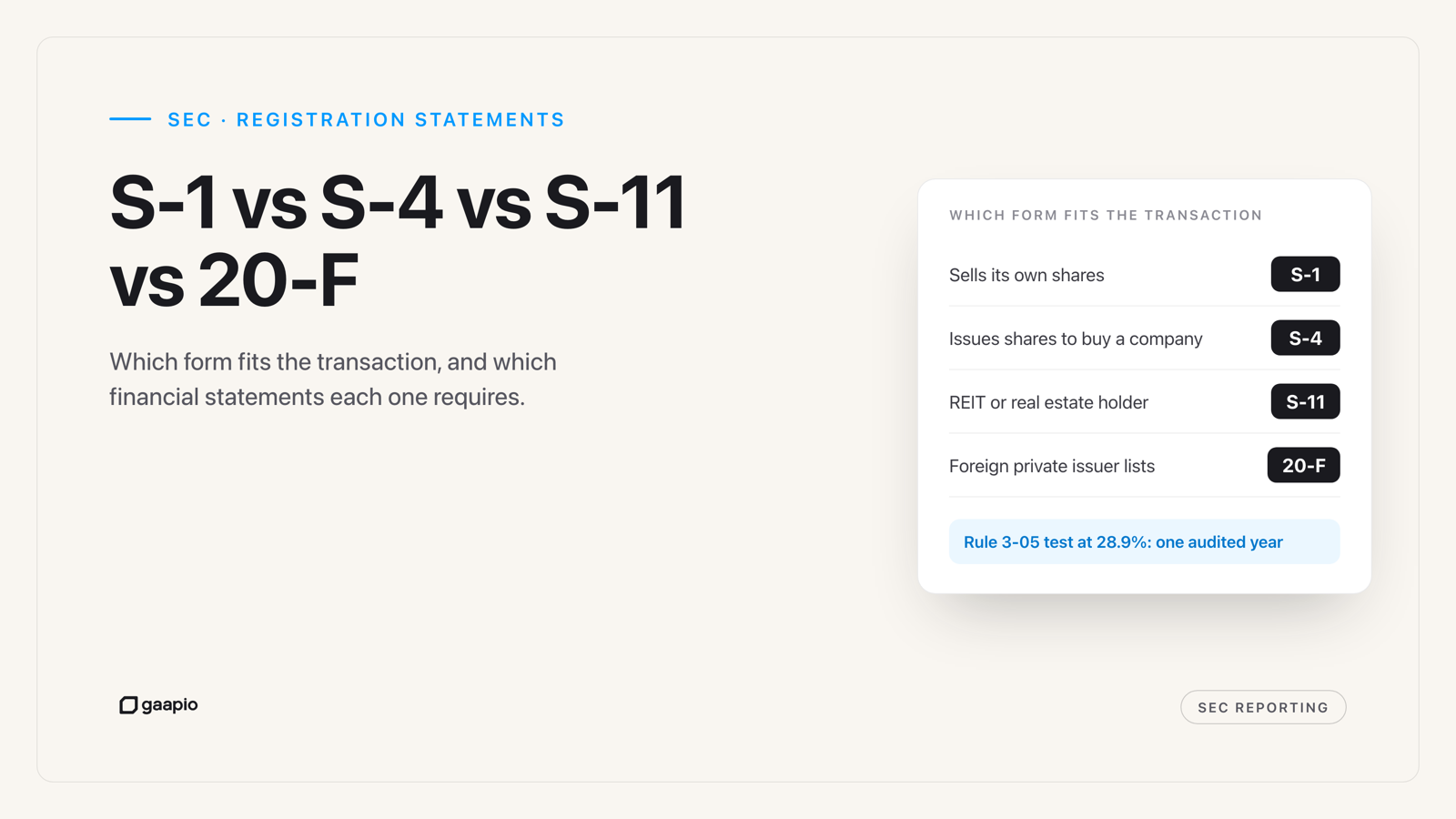
Next time someone on the deal team says "we'll just file an S-1," ask what the company is registering, and for whom. The form follows the transaction. A company going public files one form. A company issuing its own shares to buy another company files a second. A REIT files a third. A foreign private issuer listing in the U.S. may file a fourth that isn't a Securities Act registration statement at all.
Picking the wrong form costs time, because the form decides which financial statements your technical accounting team drafts, which periods your auditor covers, and how current those numbers have to be. This guide sorts out Form S-1, Form S-4, Form S-11, Form 20-F and Form S-3, explains confidential draft submissions, and ends with a worked example of the financial statement and MD&A workstreams behind a first S-1, including an acquisition under Regulation S-X Rule 3-05 and Article 11.
Key takeaway: Form S-1 registers a U.S. company's own securities, usually in an IPO. Form S-4 registers securities issued in a merger, exchange offer or de-SPAC transaction, and, when a shareholder vote is needed, doubles as the proxy statement. Form S-11 is for REITs and companies that primarily hold real estate for investment. Form 20-F is a foreign private issuer's Exchange Act registration statement and annual report, and it is not a Securities Act offering form. Form S-3 is the short form for seasoned reporting companies. For the domestic forms, Regulation S-X decides the audited periods, the age of the financials and the pro forma information, and Form 20-F sets its own periods and age limits in Item 8.
What is the difference between Form S-1, S-4, S-11 and 20-F?
Form S-1 covers what a company sells to the public. Form S-4 covers what shareholders of two companies receive in a deal. Form S-11 covers the real estate a company owns and how it is financed. Form 20-F covers a foreign private issuer that becomes, or stays, an SEC reporting company.
| Form | Who files it, and when | Audited financial statements (Regulation S-X) | Age of financials | Relief |
|---|---|---|---|---|
| S-1 | A U.S. company registering its own securities: IPOs, direct listings, SPAC IPOs, and follow-ons by companies that aren't eligible for S-3 | Balance sheets for 2 years. Income, comprehensive income, cash flows and equity for 3 years. Plus Rule 3-05 financial statements and Article 11 pro formas if an acquisition is involved | Generally no more than 134 days old at filing and effectiveness. Audited year-end statements are required once an IPO issuer is more than 45 days past year-end | Emerging growth company (EGC): 2 years of audited statements in an IPO of common equity. Smaller reporting company (SRC): 2 years and scaled disclosure |
| S-4 | The acquirer (or a new holding company) issuing securities in a merger, exchange offer or de-SPAC transaction. The target doesn't file, except as a co-registrant when a SPAC or other shell company registers a de-SPAC | The registrant's statements under Item 14, or by reference if it is S-3 eligible. The target's information under Item 17. Article 11 pro formas for the deal under Item 5 | Rule 3-12 applies: 134 days for most registrants, 129 for accelerated and large accelerated filers, measured at effectiveness or the proxy mailing date. When the registrant incorporates by reference, the prospectus must reach holders 20 business days before the meeting | EGC and SRC scaling applies to the registrant. A non-reporting target's latest year needs to be audited only to the extent practicable, and earlier years need not be audited if they weren't before (not in de-SPACs, where Rule 15-01 applies) |
| S-11 | A REIT, or another company whose business is primarily acquiring and holding real estate for investment | The S-1 periods, plus Rule 3-14 statements of revenues and expenses for acquired real estate operations and Schedule III | Same as S-1 | Same EGC and SRC relief as S-1 |
| S-3 | A reporting company that has filed timely for at least 12 calendar months. Primary offerings need $75 million of public float, with a limit for smaller companies | Incorporates the 10-K and later reports by reference | Follows the incorporated reports | The SEC proposed in May 2026 to loosen eligibility. Not final as of this writing |
| 20-F | A foreign private issuer, as an Exchange Act registration statement or as the annual report due within four months of year-end | Three years of audited statements (an EGC needs two in an IPO registration statement), under IFRS as issued by the IASB, U.S. GAAP, or home-country GAAP reconciled to U.S. GAAP | Audited year no older than 15 months at effectiveness, and 12 months at filing for an IPO unless the issuer represents the 12-month rule isn't required elsewhere and is impracticable. Interims if the document is dated more than nine months after the audited year | EGC accommodations apply. SRC scaling isn't available on Form 20-F |
Two cautions on the table. The year counts shift when a company is an EGC or SRC, so check status first. And each cell compresses a rule with exceptions, so confirm the details for your facts with securities counsel and your auditor.
What is an S-1 filing?
An S-1 filing is the registration statement a U.S. company files with the SEC under the Securities Act of 1933 before it sells securities to the public. Form S-1 is the default for a domestic IPO, and it is also used for direct listings, SPAC IPOs and follow-on offerings by companies that can't yet use Form S-3.
Section 5 of the Securities Act requires an offer or sale to be registered or exempt. Once the registration statement is effective, Section 11 makes the issuer, its signing officers, every director, the underwriters and experts such as the auditor (for its report) liable for material misstatements, with a due-diligence defense available to everyone but the issuer. Effectiveness is not an SEC endorsement of the company or the offering.
The form has two parts. Part I is the prospectus, which carries the business description, risk factors, use of proceeds, dilution, MD&A, management and the financial statements. Item 11 sends the registrant to Regulation S-K for the narrative disclosures and to Regulation S-X for the financial statements, including Rule 3-05 financial statements and Article 11 pro formas when an acquisition is involved. Part II holds information that doesn't go into the prospectus, such as expenses, indemnification and exhibits. A company that lists also registers its class under the Exchange Act on Form 8-A, which is usually effective at the same time.
The registration fee is set by Section 6(b) and is based on the maximum aggregate offering price. For fees paid from October 1, 2026 through September 30, 2027, the rate is $87.00 per million dollars, down from $138.10.
Reading other companies' S-1s on EDGAR, including the amendments, is the fastest way to see how a similar company handled a judgment. The EDGAR full-text search guide covers how to find them.
When is Form S-4 used?
Form S-4 is the registration statement for securities issued in a business combination. General Instruction A says it may be used for securities issued in a Rule 145 transaction, in a merger where state law wouldn't require all of the target's holders to vote, in an exchange offer, or in a resale of securities received in one of those transactions.
The acquirer is the registrant, because it is the one issuing new securities. The target doesn't file, though its information is in the document (a de-SPAC is the exception, covered below). When the deal needs a shareholder vote, the S-4 is combined with the proxy statement, so target shareholders get one document that serves as both the prospectus and the proxy statement. Where a vote is needed, the final proxy statement and prospectus can't be mailed until the S-4 is effective.
The form is organized by who the information is about:
- Information about the transaction (Items 1 to 9): risk factors, terms of the deal, and the Article 11 pro forma financial information under Item 5
- Information about the registrant (Items 10 to 14): by reference if the registrant is S-3 eligible, otherwise Item 14 with business, properties, legal proceedings, financial statements, MD&A and market risk
- Information about the company being acquired (Items 15 to 17): by reference if it is S-3 eligible, otherwise Item 17
- Voting and management information (Items 18 and 19)
- Part II (indemnification, exhibits and undertakings)
The registrant's and the target's audited statements follow Regulation S-X, with Rule 3-05 and Article 11 coming into play for any other acquisitions. The deal itself requires pro forma combined information under Item 5. Pro forma information is often on the critical path, because it combines two sets of books before the deal closes.
When the registrant relies on incorporation by reference, General Instruction A.2 requires the prospectus to reach security holders at least 20 business days before the meeting or the date votes or consents may be used. Foreign private issuers use Form F-4, the S-4 equivalent.
Does a SPAC file a Form S-4?
Usually yes, when new shares go to the target's owners. In a de-SPAC transaction the SPAC, or a new holding company, registers the shares it issues to the target's holders on Form S-4 (or Form F-4), and the same document asks the SPAC's shareholders to vote.
The SEC adopted rules on January 24, 2024 (Release No. 33-11265) that changed this work. When a SPAC or another shell company registers a de-SPAC on Form S-4 or F-4, the target is a co-registrant and signs the registration statement, so it carries responsibility for the disclosure. De-SPAC filings require a 20-calendar-day minimum dissemination period where local law allows, added disclosure about sponsor compensation, conflicts and dilution, disclosure of the material bases and assumptions behind projections, and Rule 145a, which deems a business combination of a reporting shell company with a non-shell business to involve a sale of securities to the shell company's shareholders. The PSLRA safe harbor is not available to blank check companies, including SPACs, and it is also unavailable in an IPO.
For the accounting team, the practical result is that the target's financial statements, pro formas and projections now carry liability much closer to a traditional IPO, because the target signs as a co-registrant and the PSLRA safe harbor is unavailable.
When is Form S-11 used instead of S-1?
Use Form S-11 when the registrant is a real estate investment trust under Section 856 of the Internal Revenue Code, or another issuer whose business is primarily acquiring and holding real estate, or interests in real estate, for investment. The form's own instructions say it can't be used by a registered investment company or for asset-backed securities.
What changes from an S-1 is the content. The prospectus describes the real estate portfolio, the investment policies, the REIT's tax qualification and the financing. The financial statements follow the same Regulation S-X periods as an S-1, with two additions. Rule 3-14 requires audited statements of revenues and expenses for real estate operations the company has acquired or is about to acquire, when the investment test is above 20%. Schedule III presents real estate and accumulated depreciation. Real estate companies also lean on non-GAAP measures such as funds from operations, which carry their own Regulation S-K Item 10(e) reconciliation rules.
In practice, a seasoned REIT that meets Form S-3 eligibility registers shelf offerings on S-3, and Form S-11 General Instruction H also lets an eligible registrant incorporate by reference.
What is Form 20-F, and what is the 20-F format?
Form 20-F is the form a foreign private issuer uses as a registration statement under Section 12 of the Exchange Act or as its annual report under Section 13(a) or 15(d). The annual report is due four months after the fiscal year-end. A 20-F registration statement registers a class of securities under Section 12(b) or 12(g) without a Securities Act offering. A foreign private issuer that raises capital in the U.S. registers the offering on Form F-1 (or F-4 for a business combination) and registers the class under the Exchange Act at the same time.
A foreign private issuer, defined in Rule 3b-4, is a company incorporated outside the U.S. that has 50 percent or fewer of its voting securities held by U.S. residents. If U.S. residents hold more, it still qualifies unless a majority of its executive officers or directors are U.S. citizens or residents, more than half its assets are in the U.S., or its business is administered principally in the U.S. A reporting foreign private issuer tests its status annually as of the last business day of its second fiscal quarter. A new registrant tests as of a date within 30 days before it files its initial registration statement. A foreign private issuer can also choose to file on domestic forms.
The 20-F format has three parts:
- Part I (Items 1 to 12): identity of directors and advisers, offer statistics, key information (including risk factors), information on the company, unresolved staff comments, operating and financial review and prospects, directors and employees, major shareholders and related party transactions, financial information, the offer and listing, additional information, market risk, and securities other than equity
- Part II (Items 13 to 16K): defaults, modifications of security holder rights, controls and procedures, and the governance items, including the audit committee financial expert, code of ethics, accountant fees, cybersecurity and insider trading policies
- Part III (Items 17 to 19): financial statements and exhibits
On the financial statements, Item 8 asks for three years of audited comparative statements, audited by an independent auditor, with the last audited year no older than 15 months when the registration statement becomes effective and, for an IPO, no older than 12 months when the document is filed, unless the company files, as an exhibit, a representation that it isn't required to meet a 12-month rule in any jurisdiction outside the United States and that complying is impracticable or involves undue hardship. If the document is dated more than nine months after the audited year, it needs interim statements covering at least six months. Statements can be IFRS as issued by the IASB without a U.S. GAAP reconciliation, U.S. GAAP, or home-country GAAP reconciled to U.S. GAAP under Item 18.
An issuer's own financial statements in a 20-F registration statement or annual report must meet Item 18. When those statements use a basis other than IFRS as issued by the IASB, Item 18 requires a U.S. GAAP reconciliation and all other information that U.S. GAAP and Regulation S-X require. Item 17's narrower standard is now mostly limited to financial statements of other entities, such as acquired businesses under Rule 3-05.
In June 2025 the SEC issued a concept release (Release No. 33-11376) asking whether to revise the foreign private issuer definition. As of this writing the SEC has not proposed rule changes, so status is still tested under current Rule 3b-4.
What is a confidential S-1 submission?
A confidential S-1 submission is a draft registration statement sent to the SEC for nonpublic review before the company files publicly. The staff reviews the draft and comments on it, and the market doesn't see the filing until the company decides to proceed.
The JOBS Act gave EGCs this option. The staff extended nonpublic review to all issuers for IPOs in 2017 and widened it again on March 3, 2025. Now all issuers can use it for IPOs and for later offerings no matter how long they have reported, and later offerings need public filing only two business days before the requested effective time. It also covers initial Exchange Act registrations on Forms 10, 20-F and 40-F, and de-SPAC transactions where the SPAC survives, if the target is eligible.
The rules that matter in practice:
- The 15-day rule: an IPO issuer confirms in its cover letter that it will file the registration statement and its draft submissions publicly at least 15 days before any road show, or 15 days before the requested effective date if there is no road show.
- What the draft can leave out: the first draft can omit underwriter names. An EGC can also omit financial statements for historical periods it reasonably believes won't be required at the time of the offering. Other issuers can omit, from draft submissions only, financial information they reasonably believe won't be required when they file publicly. All Regulation S-X financial information has to be included before a preliminary prospectus goes to investors.
- What becomes public: draft submissions don't appear on EDGAR until the public filing, when the company files its drafts too. The staff's comment letters are released later, no earlier than 20 business days after the registration statement becomes effective.
- Testing the waters: Rule 163B lets any issuer gauge interest from qualified institutional buyers and institutional accredited investors before or after it files.
For accounting teams, the draft submission is a reason to start early. The first draft has to be a complete, reviewable document, and the periods you can leave out depend on when you expect to price.
When can a company use Form S-3 instead of S-1?
A company can use Form S-3 when it has been an Exchange Act reporting company for at least 12 calendar months, has filed its reports on time in that period, and meets the float test. For a primary offering, General Instruction I.B.1 requires $75 million or more of voting and non-voting common equity held by non-affiliates. Below $75 million, a company with common equity listed on a national exchange that isn't a shell company can sell up to one-third of its public float in any 12 months under I.B.6. Well-known seasoned issuers get more flexibility.
S-3 is short because it incorporates the company's 10-K and later reports by reference. That is the reason the 10-K versus 10-Q comparison matters to a registration statement: the S-3 is only as good as the periodic reports behind it.
On May 19, 2026, the SEC proposed two rulemakings that would change this. The registered offering reform proposal (Release No. 33-11418) would remove the 12-month seasoning requirement and the $75 million float test for S-3 and extend automatic shelf benefits to more issuers. The filer status proposal (Release No. 33-11419) would collapse filer categories into large accelerated and non-accelerated filers, give non-accelerated filers substantially the same scaled disclosure now available to SRCs and EGCs, and add a 60-month on-ramp before large accelerated filer status can apply. As of this writing the SEC has not adopted either one, so plan on current rules and recheck before you file.
Which form does your transaction require?
Work through these in order:
- Are you issuing securities to acquire another business or to exchange for another company's securities? File on S-4 (F-4 for a foreign private issuer).
- Are you a REIT, or primarily a holder of real estate for investment? Use S-11, unless you are S-3 eligible.
- Are you a foreign private issuer? Register an offering on F-1 (F-3 if eligible), or list without an offering on Form 20-F.
- Have you reported under the Exchange Act for 12 months and filed on time? Check Form S-3 eligibility.
- Otherwise, a U.S. company selling its own securities files on S-1.
Mixed cases exist: a REIT issuing stock in a merger files an S-4 that also carries S-11 information, and a company can be both an EGC and an SRC. Take the facts to securities counsel before you commit to a form.
What financial statements does Regulation S-X require?
For the domestic forms above, Regulation S-X sets four things: the audited periods, the interim periods, the age of the statements, and the extra financial statements for acquired businesses. The registration form decides where the rules apply.
Audited periods. A company that is not an EGC or SRC presents balance sheets for two years and statements of operations, comprehensive income, cash flows and equity for three years. Deloitte's Roadmap on IPOs says the number of periods "depends on the registrant's status as an EGC or SRC" (section 2.4). An EGC in an IPO of common equity presents two years, and an SRC presents two years.
EGC status. A company is an EGC if its total annual gross revenues were less than $1.235 billion in its most recently completed fiscal year. Status runs until the earliest of the last day of the fiscal year after the fifth anniversary of the first registered sale of common equity, the fiscal year in which revenues reach $1.235 billion, the date it has issued more than $1 billion of non-convertible debt in three years, or the date it becomes a large accelerated filer. An EGC can also elect to use the extended transition period for new accounting standards, and the cover page says whether it did.
SRC status. An issuer is an SRC if its public float is under $250 million, or if its annual revenues are under $100 million and its public float is under $700 million (or it has no public float). In an IPO, public float is measured within 30 days of filing the registration statement and includes the shares being registered at the estimated offering price.
Age of the financials. Under Rule 3-12, statements are generally no more than 134 days old at filing and effectiveness, or 129 days for accelerated and large accelerated filers. For a company with a December year-end, that makes September 30 statements usable through about February 11 and audited year-end statements usable through May 14. After 45 days past year-end, an IPO issuer needs audited year-end statements. Rule 3-01(c) lets a reporting company that has filed all required reports, expects after-tax income for the year and reported income in at least one of the two prior years wait until 60, 75 or 90 days after year-end, depending on filer status. An IPO issuer can't use it.
Acquired businesses and pro formas. Rule 3-05 asks whether a business acquired or probable to be acquired is significant. The tests in Rule 1-02(w) are the investment test, the asset test and the income test, which uses the lower of a revenue and a pre-tax income component. If no test is above 20%, no separate financial statements are required for that acquisition, unless individually insignificant acquisitions exceed 50% in the aggregate. The income test uses the lower of the two components only when both companies have material revenue in each of the two most recent years. Otherwise only the pre-tax income component applies. If any test is above 20% but none above 40%, the registrant needs the most recent fiscal year and the latest interim period. Above 40%, it needs at least the two most recent fiscal years. Where the tests exceed 20%, Article 11 pro forma information is generally required as well. In an IPO, when the registrant has no market capitalization, the investment test compares the consideration to the registrant's total assets at the end of its most recent fiscal year.
What does a pre-IPO checklist look like for the accounting team?
A pre-IPO checklist covers more than the forms. This is the accounting side, in the order the work tends to arrive:
- Confirm the form and the filer status. Form, EGC status, SRC status and the 134-day calendar, with counsel.
- Engage a PCAOB-registered auditor that is independent under SEC rules, and plan the audits of each period in the registration statement.
- Lift the historical statements to public company standards. Earnings per share (ASC 260), segment reporting (ASC 280) and the other disclosures that private company statements skip, and decide on the EGC extended transition period.
- Inventory acquisitions and dispositions and run the Rule 1-02(w) significance tests, because a deal that hasn't been in your audited results for nine months to a full fiscal year, or a target that is a predecessor, can require separate audited financial statements.
- Document the equity compensation history (ASC 718): the valuation of common stock for grants in the months before the IPO will get the staff's attention.
- Write MD&A with critical accounting estimates, liquidity and any key business metrics and non-GAAP measures, and reconcile each to its source.
- Build the disclosure checklist and map each line to an owner. The SEC disclosure checklist is a starting point.
- Assess internal control readiness. Management's assessment of internal control starts with the second annual report, and the auditor's attestation applies once the company is no longer an EGC and is an accelerated or large accelerated filer.
- Submit the draft confidentially if you choose to, and set the public filing date at least 15 days ahead of the road show.
- Calculate the fee and plan the comfort letter process with the underwriters.
What does the technical accounting team draft and get audited for an S-1?
Here is how those pieces fit together on one illustrative filing. Harlow Systems, Inc. is a made-up U.S. software company with a December year-end. It had $240 million of revenue in fiscal 2025, well under the $1.235 billion EGC ceiling. With revenue above $100 million and a public float that will exceed $250 million once the offered shares are counted, it is not an SRC. It has no public equity, and total assets at December 31, 2025 were $180 million. The plan is a Nasdaq IPO of up to $300 million, including the underwriters' over-allotment option, priced in April 2027. The figures are invented to show the mechanics.
The calendar. Harlow submits a draft registration statement in December 2026. The staff comments in January and February. The fiscal 2026 audit finishes in February, and Harlow files publicly in early March, at least 15 days before the road show starts in late March. It expects effectiveness in April, ahead of May 14, the last day the December 31, 2026 balance sheet can be used.
Workstream 1: the financial statements. Harlow expects to price after its fiscal 2026 audit is done. At that point an EGC needs fiscal 2026 and fiscal 2025, so fiscal 2024 won't be required at the offering and Harlow can leave it out of the December draft. The draft carries audited fiscal 2025 and unaudited nine-month statements for 2026 and 2025. In March it adds audited fiscal 2026 statements, and the nine-month interims for both years drop out. Every audited period in the filing needs a report under PCAOB standards, so the auditor performs whatever additional work that requires and reissues its reports. The team also confirms the firm is independent under SEC rules. For a first-time filer, the SEC staff generally applies SEC independence rules, including the non-audit services prohibitions, to the most recent audited fiscal year, and accepts AICPA independence for earlier years. The statements gain public company items: EPS under ASC 260 and segment disclosures under ASC 280. The team also reviews private company elections and accounting standards adoption dates, and decides whether to use the EGC extended transition period.
Workstream 2: equity compensation. The team ties the fair value of common stock to the expected IPO price for every grant in the months before the offering. If the gap is large, the staff asks why, so the valuations, the assumptions and the events between grant dates get written up before the first comment letter arrives.
Workstream 3: MD&A. The MD&A covers the two years presented, with a results discussion by line item, liquidity and capital resources, critical accounting estimates, and the key performance indicators management uses to run the business, with clear definitions and calculations. Selected financial data is no longer required. Non-GAAP measures such as adjusted EBITDA need the Regulation S-K Item 10(e) presentation and a reconciliation. The MD&A is not audited. The auditor ties the numbers through the comfort letter process the underwriters ask for.
Workstream 4: the acquisition (Rule 3-05 and Article 11). On August 3, 2026, Harlow bought Brightline Analytics, a private company, for $52 million in cash. Harlow runs the Rule 1-02(w) tests against its fiscal 2025 statements:
- Investment test: $52 million of consideration against $180 million of total assets, because Harlow has no market value. That is 28.9%.
- Asset test: Brightline's $34 million of total assets against $180 million. That is 18.9%.
- Income test: Brightline's $29 million of revenue against Harlow's $240 million is 12.1%, and its pre-tax loss of $3 million against Harlow's pre-tax loss of $21 million is 14.3%. The rule uses the lower of the two, 12.1%.
(Both companies had material revenue in 2024 and 2025, and Harlow's 2025 loss isn't 10% or more below its five-year average, so no income averaging applies.) The highest result is the investment test at 28.9%, above 20% and below 40%. Harlow needs Brightline's audited fiscal 2025 financial statements and unaudited interim statements for the six months ended June 30, 2026, the latest interim period before the acquisition. At the 20% to 40% level the comparative 2025 interim period isn't required. Those statements stay in the March filing because Harlow's audited 2026 results will include Brightline for less than nine months. By then Brightline's separate balance sheet can drop out, because Harlow's audited December 31, 2026 balance sheet already includes Brightline. Brightline's unaudited results from January 1 to August 2, 2026 still feed the pro forma income statements. Because Brightline is not an issuer and not a predecessor, its audit can be performed under AICPA auditing standards, and its auditor doesn't need to be PCAOB-registered. The team then builds Article 11 pro forma information. In the December draft, the September 30, 2026 balance sheet already includes Brightline, so the acquisition needs no pro forma balance sheet. Other IPO-related events, such as a preferred stock conversion, may still call for pro forma balance sheet and earnings per share columns. The pro forma income statements cover fiscal 2025 and the nine months, as if the deal had closed on January 1, 2025, with transaction accounting adjustments for the purchase price allocation, intangible asset amortization and, if the purchase was debt-financed, interest expense. In March, with fiscal 2026 audited, the pro forma income statement covers fiscal 2026 alone, as if the acquisition had closed on January 1, 2026. The purchase accounting under ASC 805 feeds directly into those adjustments, so the valuation work is on the critical path.
Workstream 5: the fee. The registration fee is $300 million times $87.00 per million, which is $26,100, paid when Harlow files publicly.
Starting each workstream with a memo gives the team one record to reconcile the financial statements, MD&A and pro formas against before the staff reads them side by side.
What changes after a registration statement is effective?
A company that completes an IPO, or an S-4 registrant that wasn't already reporting, becomes an SEC reporting company, with a 10-K, 10-Q and 8-K calendar, which the 10-K vs 10-Q vs 8-K guide lays out, plus Section 16, proxy rules and SOX. Regulation FD applies from the first day, though it excludes communications made in connection with a registered offering. Read the Regulation FD and Form 8-K guide before the first earnings call, because the 24-hour clock does not wait for the new reporting team to settle in.
How does Gaapio help with a first S-1?
Gaapio is an AI-powered technical accounting platform built by CPAs. For a first-time registrant, Gaapio builds the memo library and the disclosure documentation that a first S-1 and 10-K require, with each memo cited to the Codification. It runs a disclosure gap assessment that compares your current disclosures to registrant requirements and itemizes the differences, and it shows which significant judgments have memos, which have conclusions with no support, and which have neither. The IPO readiness page has the detail. Gaapio does not replace your audit firm, your IPO advisor or underwriters' counsel. These documents get read by auditors, underwriters' counsel and eventually the SEC staff, so every memo is built for review.
If you want to see that on your own filing, request a demo.
This article is general information, not legal advice. The choice of registration form, filer status and offering structure depends on specific facts and should be made with securities counsel and your auditor.
Frequently asked questions
What is an S-1 filing?
An S-1 filing is the registration statement a U.S. company files with the SEC under the Securities Act of 1933 to register securities it plans to sell to the public. It is the standard form for a domestic IPO. It contains a prospectus with the business description, risk factors, MD&A and audited financial statements, plus supplemental information in Part II.
What is Form S-4 in simple terms?
Form S-4 is the registration statement an acquirer files when it issues securities as consideration in a merger, exchange offer or similar business combination. When shareholders vote on the deal, it combines the prospectus with the proxy statement, and it includes information about both companies and pro forma financial information for the deal.
What is the difference between an S-1 and an S-4?
An S-1 usually registers securities a company sells for cash, typically in an IPO, and its financial statements are the registrant's own. An S-4 registers securities issued to the target's holders in a business combination, includes information about both companies, and, when shareholders vote, doubles as the proxy statement. An S-4 also requires Article 11 pro forma information for the deal.
Does a SPAC file a Form S-4?
Usually, when the SPAC issues new shares to the target's owners in a de-SPAC transaction. The SPAC (or a new holding company) registers those shares on Form S-4, or Form F-4 for a foreign private issuer. The SEC's 2024 SPAC rules require the target to be a co-registrant when a SPAC or other shell company registers the deal, and add a 20-calendar-day minimum dissemination period.
When do you use Form S-11 instead of Form S-1?
Use S-11 when the registrant is a REIT or another company whose business is primarily acquiring and holding real estate for investment. It can't be used by a registered investment company or for asset-backed securities. Its financial statements follow the S-1 periods, with Rule 3-14 statements for acquired real estate operations and Schedule III.
What is a 20-F form, and what is the 20-F format?
Form 20-F is a foreign private issuer's Exchange Act registration statement and annual report. The annual report is due four months after year-end. The format has three parts: Part I (Items 1 to 12) covers the company and its financial review, Part II (Items 13 to 16K) covers controls and governance, and Part III (Items 17 to 19) covers financial statements and exhibits.
What is a confidential S-1, and who can use it?
A confidential S-1 is a draft registration statement submitted to the SEC for nonpublic review. EGCs have had this option since the JOBS Act, and since 2017 the staff has offered it to all issuers for IPOs. In March 2025 it was widened to all later offerings regardless of how long the issuer has reported, to Section 12(g) registrations on Forms 10, 20-F and 40-F, and to de-SPAC transactions where the SPAC survives. An IPO issuer must file publicly at least 15 days before the road show.
How much is the SEC registration fee for an S-1?
The fee is based on the maximum aggregate offering price. For fees paid from October 1, 2026, the rate under Section 6(b) is $87.00 per million dollars, down from $138.10. A $300 million offering would carry a fee of $26,100, which is paid when the company files publicly.
How long are financial statements valid in a registration statement?
Generally they can be no more than 134 days old at filing and effectiveness. An IPO issuer also needs audited year-end statements once it is more than 45 days past year-end. For a December year-end, audited statements remain usable through May 14 of the following year, and September 30 interim statements through about February 11. Accelerated and large accelerated filers have 129 days.
Related reading
- IPO readiness: the technical accounting work behind a first S-1
- 10-K vs. 10-Q vs. 8-K: Differences and 2026 Filing Deadlines
- Regulation FD and Form 8-K: The 2026 Guide to SEC Fair Disclosure
Sources
- Form S-1 (SEC)
- Form S-3 (SEC)
- Form S-4 (SEC)
- Form S-11 (SEC)
- Form 20-F (SEC)
- 17 CFR 210.3-05, acquired businesses (eCFR)
- 17 CFR 210.3-14, real estate operations (eCFR)
- 17 CFR 210.1-02, significant subsidiary tests (eCFR)
- 17 CFR 210.11-01, pro forma financial information (eCFR)
- 17 CFR 210.3-12, age of financial statements (eCFR)
- 17 CFR 240.12b-2, EGC and SRC definitions (eCFR)
- SEC, Draft Registration Statement Processing Procedures Expanded (March 3, 2025)
- SEC, Fee Rate Advisory for Fiscal Year 2027
- SEC fact sheet, SPACs, Shell Companies, and Projections: Final Rules (Release No. 33-11265)
- SEC, Emerging Growth Companies
- SEC Chairman Atkins, statement on the May 19, 2026 proposals (Release Nos. 33-11418 and 33-11419)
- Manatt, SEC Proposes Significant Changes to Advance "Make IPOs Great Again" Agenda
- Torys, SEC considers amending definition of foreign private issuer (June 2025)
- Deloitte, Roadmap: Initial Public Offerings, section 2.4, Financial Statement Periods Presented